Sunday, October 29, 2017

Facts About Earth

  • The Earth’s rotation is gradually slowing.
  • This deceleration is happening almost imperceptibly, at approximately 17 milliseconds per hundred years, although the rate at which it occurs is not perfectly uniform. This has the effect of lengthening our days, but it happens so slowly that it could be as much as 140 million years before the length of a day will have increased to 25 hours.
  • The Earth was once believed to be the centre of the universe.
  • Due to the apparent movements of the Sun and planets in relation to their viewpoint, ancient scientists insisted that the Earth remained static, whilst other celestial bodies travelled in circular orbits around it. Eventually, the view that the Sun was at the centre of the universe was postulated by Copernicus, though this is also not the case.
  • Earth has a powerful magnetic field.
  • This phenomenon is caused by the nickel-iron core of the planet, coupled with its rapid rotation. This field protects the Earth from the effects of solar wind.
  • There is only one natural satellite of the planet Earth.
  • As a percentage of the size of the body it orbits, the Moon is the largest satellite of any planet in our solar system. In real terms, however, it is only the fifth largest natural satellite.
  • Earth is the only planet not named after a god.
  • The other seven planets in our solar system are all named after Roman gods or goddesses. Although only MercuryVenusMarsJupiter and Saturn were named during ancient times, because they were visible to the naked eye, the Roman method of naming planets was retained after the discovery of Uranus and Neptune.
  • The Earth is the densest planet in the Solar System.
  • This varies according to the part of the planet; for example, the metallic core is denser than the crust. The average density of the Earth is approximately 5.52 grams per cubic centimetre.

New Discovered Plants

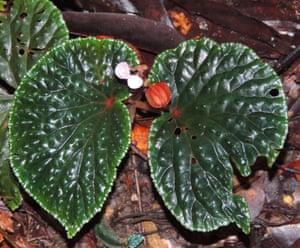
Begonia ruthiae was found along the trails of the Danum Valley in Sabah, in one of the last remaining areas of unlogged lowland forest in Borneo. It was named after Dr Ruth Kiew, who has spent many years studying the limestone flora of both Borneo and peninsular Malaysia.
Begonia Ruthiae

Begonia ruthiae was found along the trails of the Danum valley in Sabah, in one of the last remaining areas of unlogged lowland forest in Borneo. It was named after Dr Ruth Kiew, who has spent many years studying the limestone flora of both Borneo and peninsular Malaysia.


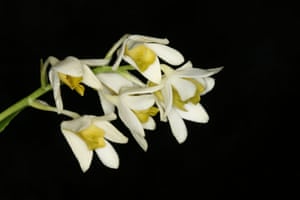
Among the new orchids discovered and published in 2015 is Dendrobium cynthiae, named for its grower in the US, who acquired it from a dealer. The pretty white flowers have a green lip. The wild origin of the species is unknown, but believed to be New Guinea.
Dendrobium cynthiae

Among the new orchids discovered and published in 2015 isDendrobium cynthiae, named for its grower in the US, who acquired it from a dealer. The pretty white flowers have a green lip. The wild origin of the species is unknown, but believed to be New Guinea.


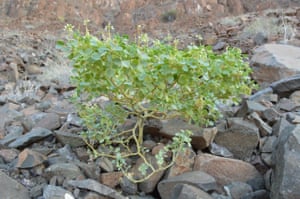
Oberholzeria
Oberholzeria etendekaensis

Perhaps the most exciting legume discovery of 2015 is Oberholzeria etendekaensis, a succulent shrublet, which is not only a new species but also in a new genus. It is known only from a single locality with 30 individuals in the Kaokoveld Centre of Plant Endemism, north-western Namibia.


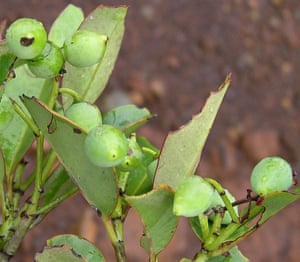
Four genera new to science were discovered in 2015. The first of these was Jaffrea, a shrub in the buckthorn family Rhamnaceae, which is specific to metal-rich soils in New Caledonia
Jaffrea

Four genera new to science were discovered in 2015. The first of these was Jaffrea, a shrub in the buckthorn family Rhamnaceae, which is specific to metal-rich soils in New Caledonia.


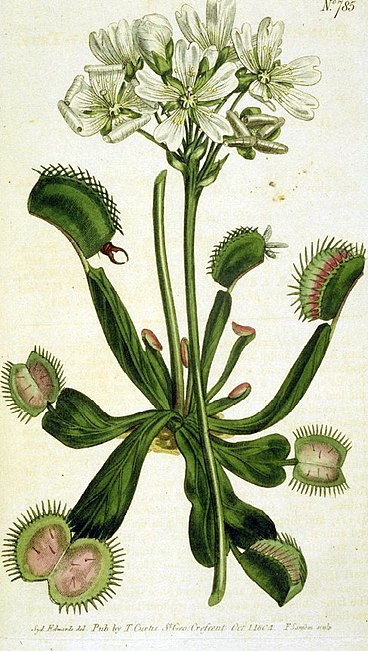
Dionaea muscipula: the Venus Fly Trap
The Venus Fly Trap is the most famous of all carnivorous plants due to the active and efficient nature of its unique traps. It may be famous, but it's also threatened. The plant's two hinged leaves are covered in ultra sensitive fine hairs that detect the presence of everything from ants to arachnids. Trigger the hairs and snap! The trap will shut in less than a second.


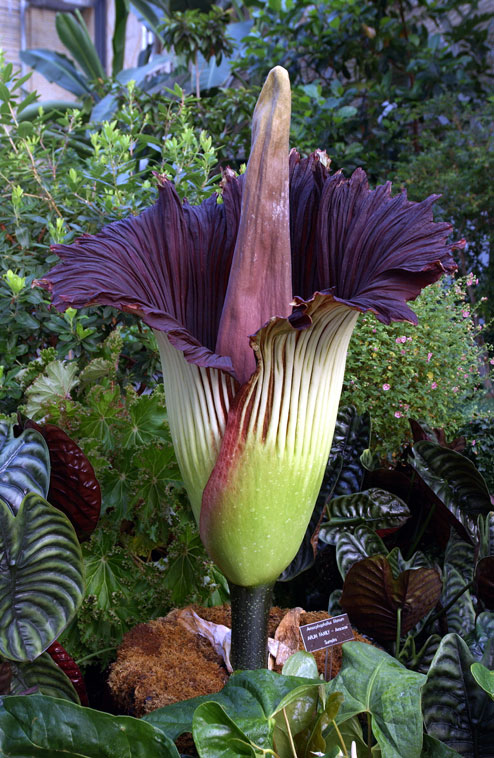
Amorphophallus titanum:the Corpse Flower
A flower taller than a man, stinking strongly of putrefying roadkill and colored deep burgundy to mimic rotting flesh, sounds like something from a low-budget science fiction movie. But Indonesia's titan arum—or "corpse flower," as known by locals—is a real, if rare, phenomenon, pollinated in the wild by carrion-seeking insects. This Indonesian plant, called titan arum or amorphophallus titanium, has the world's biggest inflorescence. Due to its fragrance, which is reminiscent of the smell of a decomposing mammal, the Titan Arum is also known as a carrion flower, the "Corpse flower", or "Corpse plant".


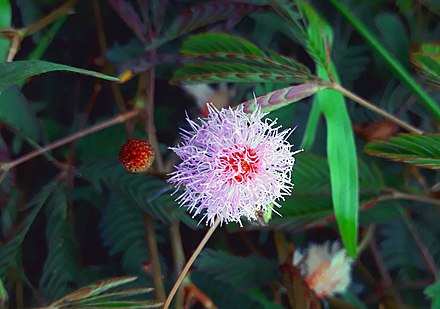
Mimosa pĂșdica: the Shy Plant
Mimosa Pudica (pudica = shy), or the Sensitive Plant, has a curiosity value: the compound leaves fold inward and droop when touched or shaken, re-opening within minutes. The species is native to South America and Central America, but is now a pantropical weed. Who would know that plants have feelings too?

Thursday, October 26, 2017

New Discovered Animals

Giant Tortoise (Chelonoidis donfaustol).

 A distinct species of giant tortoise was discovered on the island of Santa Cruz in the Galapagos off the coast of Ecuador.


Gryffindor’s Hat (Eriovixia gryffindori)
They may be little, but they’re also just a bit magical. At only 2 millimeters in length, these tiny spiders are the smallest creatures to make the list this year, and do so because of their striking resemblance to the infamous hat once owned by the famed wizard Godric Gryffindor.


Rose-tinted katydid (Eulophophyllum kirki)

Only one specimen of this beautifully colored insect has ever been found, which uses its incredibly mimicry to blend in with the foliage in which it lives. While the males are a more standard green, the females are resplendent in all their pink finery.


The indiscriminate rat (Gracilimus radix)
While most rodents are fairly consistently carnivorous, preferring to dine on other animals, this Indonesian cutie wants it all, and is one of the few truly omnivorous rats. Found only on the island of Sulawesi, this beastie is so unusual that it has been placed in its own genus.


No eyes, four penises, and many legs (Illacme tobini)
Measuring in at just 20 millimeters long and with up to 750 legs, these little millipedes are living proof that it’s not size that counts. Hailing from a long line of millipedes that go back more than 200 million years, these American insects come from good stock.


A fiery contender (Pheidole drogon)
While this species of ant may not be able to contend with its namesake in size, it sure makes up for it in appearance. The spiky armor of this New Guinean insect reminded the researchers who discovered it so much of Daenerys Targaryen’s rouge dragon that they decided to name the ant after it.


The deep-sea sock (Xenoturbella churro)
With no eyes, no brain, no gut, and no anus, these bizarre deep-sea worms have puzzled biologists for more than 60 years. This year saw them finally placed on the evolutionary tree, as well as described as a new species that (apparently) looks like the delicious Spanish snack churros.